

Hey there! I'm an OEM CNC machining parts supplier, and I've been in this game for quite a while. Over the years, I've seen a lot of factors that can affect the price of OEM CNC machining parts. In this blog, I'll share some of these factors with you.
Material Costs
One of the most obvious factors affecting the price of OEM CNC machining parts is the cost of materials. Different materials have different prices, and some are much more expensive than others. For example, if you're using high - end metals like titanium, the cost is going to be significantly higher compared to using aluminum or steel.
Titanium is known for its high strength - to - weight ratio, corrosion resistance, and biocompatibility. These properties make it ideal for applications in aerospace, medical, and high - performance automotive industries. However, the extraction and processing of titanium are complex and costly, which drives up the price of the raw material. On the other hand, aluminum is relatively inexpensive. It's lightweight, easy to machine, and has good corrosion resistance, making it a popular choice for many general - purpose CNC machining parts.
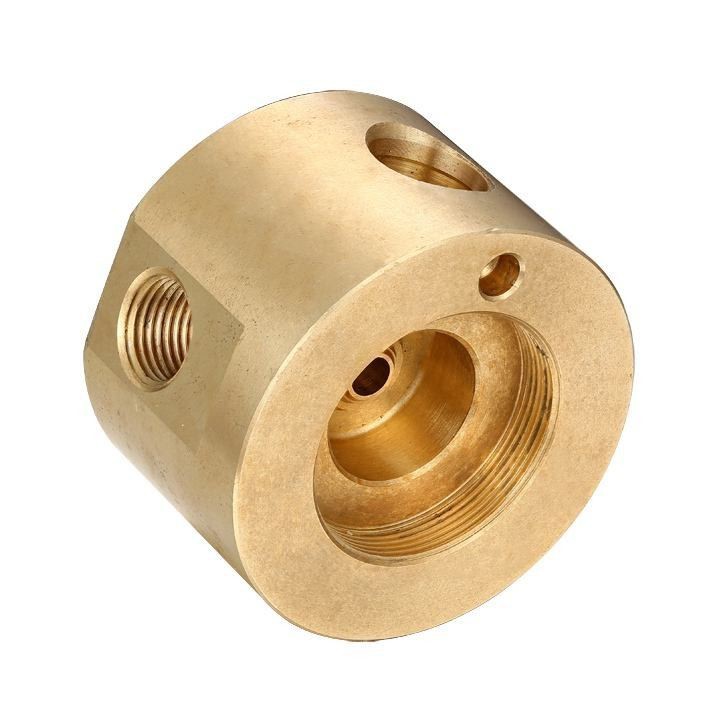
Another aspect of material costs is the quality of the material. Higher - quality materials usually come with a higher price tag. For instance, if you need a brass with a very high purity for Brass CNC Machining Parts, you'll end up paying more. The cost also includes the waste generated during the machining process. Some materials are more difficult to machine, resulting in more waste, which in turn increases the overall material cost for the final part.
Complexity of Design
The complexity of the part's design is a major factor in determining its price. Simple parts with basic shapes and few features are generally cheaper to manufacture. These parts can be machined more quickly and with less tooling and setup time. For example, a simple rectangular block with a few holes drilled in it can be produced relatively fast on a CNC machine.
However, if the design is complex, with intricate curves, deep cavities, or tight tolerances, the machining process becomes much more challenging. Complex designs often require more advanced machining techniques, such as 5 Axis CNC Milling Parts. A 5 - axis CNC milling machine can move the cutting tool in five different axes simultaneously, allowing for the creation of complex geometries that would be impossible or very difficult to achieve with a 3 - axis machine. But these advanced machines are more expensive to operate, and the programming for them is also more complex, which all adds to the cost of the part.
Tight tolerances also increase the cost. Tolerance refers to the allowable deviation from the specified dimensions of a part. The tighter the tolerance, the more precise the machining process needs to be. Achieving tight tolerances often requires more precise tools, slower machining speeds, and additional quality control checks, all of which contribute to a higher price.
Quantity of Production
The quantity of parts you need to produce has a significant impact on the price. Generally, the more parts you order, the lower the unit cost. This is because of economies of scale. When producing a large quantity of parts, the setup costs, such as tooling and programming, can be spread over a larger number of parts.

For example, let's say the setup cost for a particular CNC machining job is $1000, and the cost to machine each part is $10. If you order 100 parts, the total cost is $1000 (setup) + $10×100 (part cost) = $2000, and the unit cost is $20. But if you order 1000 parts, the total cost is $1000 (setup) + $10×1000 (part cost) = $11000, and the unit cost drops to $11.
However, there are some limitations to this. If the production quantity is extremely large, there may be additional costs related to inventory management, storage, and potential quality control issues over a long - term production run.
Machining Time
The time it takes to machine a part is directly related to its price. Longer machining times mean higher costs, as the machine is running for a longer period, consuming more energy, and the operator's time is also being used up.
The machining time depends on several factors, including the complexity of the design, the material being machined, and the cutting parameters. As mentioned earlier, complex designs take longer to machine. Also, harder materials require slower cutting speeds to avoid tool wear and to achieve the desired surface finish, which increases the machining time.
For example, machining a CNC High - Precision CNC Machined Automotive Parts may take a long time because of the high precision required. The machine has to move slowly and precisely to ensure that all the dimensions are within the tight tolerances specified for automotive applications.
Tooling Costs
Tooling is an important cost factor in CNC machining. Different parts require different types of tools, such as end mills, drills, and taps. The cost of these tools can vary widely depending on their type, size, and quality. High - quality tools that can withstand high - speed machining and produce a better surface finish are usually more expensive.
In addition to the cost of the tools themselves, there is also the cost of tool wear and replacement. Some materials are very abrasive, which can cause the tools to wear out quickly. Frequent tool replacement means higher costs. Also, for complex parts, special - purpose tools may be required, which can be very expensive to manufacture or purchase.
Quality Control and Inspection
Ensuring the quality of the CNC machining parts is crucial, especially for applications where safety and performance are critical. Quality control and inspection processes add to the overall cost of the parts.
There are different levels of quality control. For basic parts, a simple visual inspection may be sufficient. But for parts with high precision requirements, more advanced inspection methods are needed, such as coordinate measuring machines (CMMs). CMMs can measure the dimensions of a part with very high accuracy, but they are expensive to operate and require trained personnel.
Additional testing, such as material testing or functional testing, also increases the cost. For example, if a part needs to be tested for its strength or fatigue resistance, special testing equipment and facilities are required, which all contribute to the final price of the part.
Market Conditions
The overall market conditions can also affect the price of OEM CNC machining parts. Supply and demand play a big role. If there is a high demand for a particular type of part and the supply is limited, the price is likely to go up. On the other hand, if there is an oversupply in the market, prices may drop.
Competition among CNC machining suppliers also impacts the price. In a highly competitive market, suppliers may lower their prices to attract more customers. Economic factors, such as inflation, currency exchange rates, and the cost of energy, can also have an influence. For example, if the cost of electricity (which is used to power the CNC machines) increases, the machining costs will go up, and this may be reflected in the price of the parts.
Conclusion
As you can see, there are many factors that affect the price of OEM CNC machining parts. Material costs, design complexity, production quantity, machining time, tooling costs, quality control, and market conditions all play a role. If you're in the market for CNC machining parts, it's important to understand these factors so that you can make an informed decision.
If you're interested in purchasing OEM CNC machining parts, I'd love to have a chat with you. We can discuss your specific requirements, and I'll do my best to provide you with a competitive price. Don't hesitate to reach out for a quote or to start a procurement discussion.
References
- "CNC Machining Handbook"
- Industry reports on CNC machining market trends
- Technical papers on material properties and machining processes